Showing posts with label calculator. Show all posts

Saturday, August 29, 2026

The MU Key on a Four Function Calculator and Programs for the DM42/HP 42S

 The MU Key on a Four Function Calculator and Programs for the DM42/HP 42S


Not too long ago, I purchased this very colorful, four function calculator from the University I work at, the Dexin BST DX-818.


The DX-818 is powered by a solar panel with an option to be run by an AAA battery when using the calculator in less than bright light conditions. The AAA battery is optional.


A Standard Calculator


This calculator is the standard four function key calculator, complete with the square root function, percent function, the standard three memory keys (M+, M-, and MRC), and a grand total (GT) key. A grand total is started when calculations are completed by pressing the equals key [ = ]. The grand total is both recalled and cleared when the [ GT ] is pressed.


The Markup Equation


Before we head to the calculators, the mark up is a calculation of between selling price (new), cost (old), and mark up. The markup is ratio between the selling price and cost over cost and as expressed as a percentage (%):


MU = (selling price – cost) ÷ cost = (selling price ÷ cost - 1)


Solving for the other variables yield:

selling price = cost * (1 + MU)

cost = selling price ÷ (1 + MU)

In these equations, MU is expressed as a decimal.


If let the selling price be the new value and cost be the old value, then we have the equation for percent change (Δ%):

Δ% = (new – old) ÷ old = (new ÷ old - 1)

Similarly:

new = old * (1 + Δ%)

old = new ÷ (1 + Δ%)

In these equations, Δ% is expressed as a decimal.


The Markup Key (MU)


On this particular calculator, there is an [ MU ] key. This is the markup key. Apparently, there are two types of [ MU ] key, one set of syntax for Casio calculators with the [ MU ] key. An example of a Casio calculator with an [ MU ] key is the MJ-120D plus. They way Casio calculators use the [ MU ] key is a calculation:


cost [ MU ] markup percentage [ % ] returns selling price.

Immediately pressing [ = ] returns selling price – cost.


However, some calculators, like the colorful calculator featured (I really wish I knew the model number) with the [ MU ] have another syntax, and that is what I will address from here on out.


On this particular calculator, the syntax, using one of the four arithmetic functions is:


y < +, -, ×, or ÷ > x [ MU ]


No use of the equals key is needed, unless you want to add the result to the grand total.


The four calculations with the [ MU ] key, on this particular calculator (and possibly the NewYes calculators from China) are:


Key Sequence

Formula Used

Notes

Y [ + ] X [ MU ]

100 * (Y ÷ X + 1)


Y [ - ] X [ MU ]

100 * (Y ÷ X - 1)

Calculates markup or percent change (Δ%).

Y = selling price, new value

X = cost, old value

Y [ × ] X [ MU ]

Y * (1 + X ÷ 100)

Adds X% to Y. Calculates the new value (selling price) given old value (cost) (Y) and markup (X).

Y [ ÷ ] X [ MU ]

Y ÷ (1 – X ÷ 100)

Finds the original retail price given selling price (Y) and discount rate (X). This can also be used for gross-up calculations.


Sample Calculations


Problem

Keystrokes

Result

Determine 100 * (Y ÷ X + 1) with Y = 420, X = 25

420 [ + ] 25 [ MU ]

1780

An item that cost the company $14.75 sells for $19.99. Find the markup.

19.99 [ - ] 14.75 [ MU ]

35.5254237288

(≈35.53%)

A company manufactures a product with a unit cost of $32.84 and wants a 20% markup. What is the selling price?

32.84 [ × ] 20 [ MU ]

39.408

(about $39.41)

A product is currently on sale for $39.99. If the discount is 35%, what is the original retail price.

39.99 [ ÷ ] 35 [ MU ]

61.523076923

(about $61.52)


RPN Programming with the Swiss Micros DM42


Here are four RPN programs, which are were programmed using a Swiss Micros DM42, which can be used on the HP 42S (and probably the HP 41C).


Program MU+: Y [ + ] X [ MU ]

00 {17-Byte Prgm}

01 LBL “MU+”
02 ÷

03 1

04 +

05 100

06 ×

07 RTN

08 END


Program MU-: Y [ - ] X [ MU ]

00 {17-Byte Prgm}

01 LBL “MU-”
02 ÷

03 1

04 -

05 100

06 ×

07 RTN

08 END


Program MUMLT: Y [ × ] X [ MU ]

00 {12-Byte Prgm}

01 LBL “MUMLT”
02 %

03 +

04 RTN

05 END


Program MUDIV: Y [ ÷ ] X [ MU ]

00 {21-Byte Prgm}

01 LBL “MUDIV”
02 ENTER

03 100

04 ÷

05 1

06 X<>Y

07 -

08 ÷

09 RTN

10 END


Sources


 Casio. “MJ-120D Plus” https://www.casio.com/intl/basic-calculators/product.MJ-120DPLUS/ Accessed May 23, 2026.


Eaton, Glenn. “The Calculator MU Key” Eaton Family Website. Posted on June 30, 2017. https://eatonfamily.au/calculator-mu-key/ Accessed May 23, 2026.


“How to use the MU button on a calculator? #1” YouTube Short: @newyes1162. Posted December 5, 2022. https://www.youtube.com/shorts/OiS8yFKKJSU Accessed May 23, 2026


Eddie


All original content copyright, © 2011-2026. Edward Shore. Unauthorized use and/or unauthorized distribution for commercial purposes without express and written permission from the author is strictly prohibited. This blog entry may be distributed for noncommercial purposes, provided that full credit is given to the author.


Saturday, August 8, 2026

Python: Combination Functions (Micropython)

Python: Combination Functions (Micropython)


This is a set of combination functions. Programmed with a Casio fx-CG 100 but should work on any calculator with Python.


The script is freeware.


Functions included:


 fact(n): Factorial of the non-negative integer n. Some math modules include a factorial function, like Numworks. This function will be used in all the functions on this script.


ncr(n,r): Combination


npr(n,r): Permutation


nhr(n,r): Combination, repetitions are allowed


catalan(n): nth Catalan Number


narayana(n,k): Narayana Number (n, k are positive integers)


binpdf(n,k,p): Binomial Probability:

n: trials

k: number of successes

p: probability of success


bndcdf(n,k,p): Cumulative Binomial Probability – Lower Tail

n: trials

k: number of successes (from 0 to k)

p: probability of success


Script: combo.py

'''

combinatorics 4/12/2026

Edward Shore


round to nearest integer:

int(f+.5)

'''


from math import *


# factorial positive integers

def fact(n):

  f,i=1,1

  while i<=n:

    f*=i

    i+=1

  return int(f+.5)


# a lot of functions will use fact


# combination

def ncr(n,r):

  f=fact(n)/(fact(r)*fact(n-r))

  return int(f+.5)


# permutation

def npr(n,r):

  f=fact(n)/fact(n-r)

  return int(f+.5)


# combination w/repetitions

def nhr(n,r):

  f=fact(n+r-1)/(fact(r)*fact(n-1))

  return int(f+.5)


# catalan numbers

def catalan(n):

  f=fact(2*n)/(fact(n)**2*(n+1))

  return int(f+.5)


# narayana numbers

def narayana(n,k):

  f=1/n*ncr(n,k)*ncr(n,k-1)

  return int(f+.5)


# binomial probability

def binpdf(n,k,p):

  # p=prob

  f=ncr(n,k)*p**k*(1-p)**(n-k)

  return f


# bin lower tail

def bincdf(n,k,p):

  # 0 to k, p=prob

  s=0

  for i in range(k+1):

    s+=binpdf(n,i,p)

  return s


Eddie


All original content copyright, © 2011-2026. Edward Shore. Unauthorized use and/or unauthorized distribution for commercial purposes without express and written permission from the author is strictly prohibited. This blog entry may be distributed for noncommercial purposes, provided that full credit is given to the author.


Monday, November 18, 2024

Spotlight: Akron Brass FireCalc Pocket Computer

Spotlight: Akron Brass FireCalc Pocket Computer


Welcome to a special Monday Edition of Eddie’s Math and Calculator blog.


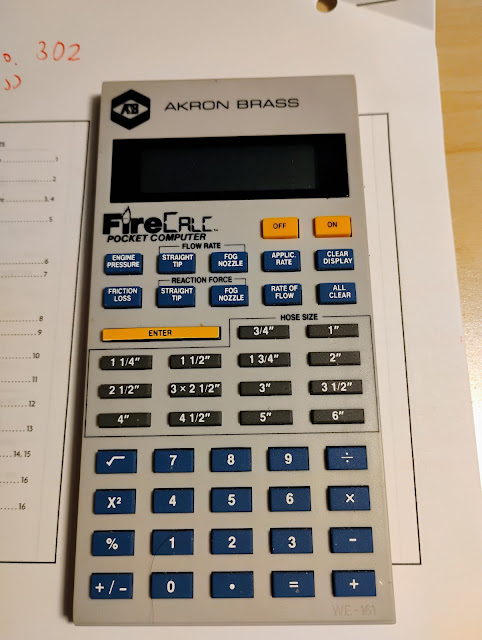
This is an instance of a small gamble and the gamble paid off because the calculator works! I found a one of a kind calculator at the Redlands Thrift Store in Redlands, CA: the Akron Brass FireCalc Pocket Computer. The specialty is mathematical calculations in fire fighting. I paid $4.95, and it probably would cost, I guess $40-$50 or higher retail because this is a specialty calculator.


Akron Brass FireCalc Pocket Computer


Akron Brass FireCalc Pocket Computer


Akron Brass FireCalc Pocket Computer


Quick Facts


Model: FireCalc Pocket Computer

Company: Akron Brass

Timeline: ????

Type: Fire Science Solver, 4 Function Calculator

Memory: No conventional memory registers, but input in the solvers are stored in memory

Power: 2 x LR44 batteries


The four function calculator has a square key, [ x^2 ], along with a square root key [ √ ]. There are two clearing keys:

[ CLEAR DISPLAY ]: acts like as clear entry key, which makes the display show 0.

[ ALL CLEAR ]: clears all the registers, and the display shows AKRON.


The display holds room for 8 digits. The display also shows alphabetic characters being built from segments.

Disclaimer: I am not a fire fighter or an expert in fire fighting mathematics. This is another topic to explore. I am going to do the best I can in describing the functions of the calculator.


A Solver for Fire Fighters


The FireCalc Pocket Computer features eight solvers. I’m going to be give a summary of how each solver as described as in the manual (see the manual section below). The solvers are the top two rows of blue keys. U.S. units are used.


There are four rows of gray keys with measurements marked ¾” all the way to 6”. Those are quick entry keys. For example, pressing [ 1 ¾” ] enters 1.75 in one keystroke.


The solvers are:


[ ENGINE PRESSURE ]: calculates the engine pressure in psi (pounds per square inch) of the water hose (I think) given the pressure, flow (gallons per minute), and length of the hose. There is also a prompt for the number of Siamese lines used (defaults to 1).

[ FRICTION LOSS ]: calculates the friction loss of a hose lay given the hose size and length. The loss is shown in psi.

(FLOW RATE) [ STRAIGHT TIP ] or [ FOG NOZZLE ]: Find the flow rate of water through the hose when it is a straight bore tip or fog nozzle in GPM (gallons per minute), respectively. For the fog nozzle, the rated nozzle pressure is skipped (the manual has it prompted).

(REACTION FORCE) [ STRAIGHT TIP ] or [ FOG NOZZLE ]: Find the reaction force in Lbs (pounds fource) of water through the hose when it is a straight bore tip or fog nozzle, respectively.

[ APPLIC. RATE ]: Find the minimum rate of water, in GPM, that is required to extinguish a fire given the rooms’ length, width, and height in feet.

[ RATE OF FLOW ]: I did not see this calculation the manual, but given from the prompts, this calculates the rate of flow of water given the following parameters: nozzle pressure, English pressure, hose size, number of Siamese lines used, number of floors, and hose length.


Because the number of solvers don’t match the manual exactly, I think this model either predates or succeeds the model described in the manual. On the back of the project it states “Cygnus of South Florida Electric Calculator. Project No. 302”. Does that mean anything?


Manual


Manual to the FireCalc from Akron Brass Company, written in 2008. It’s not the exact module that I have, but it’s pretty close: https://smhttp-ssl-61500.nexcesscdn.net/media/pdf/9900_FireCalcInstructions.pdf


Until next time, be safe and wishing you happiness (and safety from fires),


Eddie


All original content copyright, © 2011-2024. Edward Shore. Unauthorized use and/or unauthorized distribution for commercial purposes without express and written permission from the author is strictly prohibited. This blog entry may be distributed for noncommercial purposes, provided that full credit is given to the author.

Saturday, July 27, 2024

Spotlight: Texas Instruments TI-30 ECO RS: The Solar TI-30Xa

Spotlight: Texas Instruments TI-30 ECO RS: The Solar TI-30Xa


Quick Facts


Model: TI-30 ECO RS

Company: Texas Instruments

Timeline: 2015 – present (Europe

Type: Scientific calculator

Power: Solar

Display: One line, 10 digits, 2 digit exponents


Introduction


The TI-30 ECO RS is a European all-solar powered version of the battery-powered, specifically the LR44 battery, powered TI-30Xa.


Why did I get the TI-30 ECO RS? Truth be told, I am partial to solar-powered scientific calculators. I still dream of the day a solar powered (even if it is hybrid with battery) graphing calculator, that’s yet to happen. Blue is my favorite color.


Per Texas Instruments, the TI-30 ECO RS was awarded the Blue Angel award, which is a certification for the product being environmental friendly. Along with the calculator being completely solar powered, the TI-30 ECO RS is made from recycled plastic.


Features


The TI-30 ECO RS is a standard and simple scientific calculator that follows the classic TI-30 line:


* One line display, up to 10 digits. Display modes include floating pint, fixed decimal, scientific notation, and engineering notation.

* Arithmetic, powers, roots, exponential and logarithm functions

* Trigonometric functions and inverses

* Hyperbolic functions and inverses

* Fraction calculations, including fraction/decimal conversions. The maximum denominator is 999.

* One-variable statistics including mean, standard deviation, sums

* Combinations, permutations, and factorial of positive integers (up to 69)

* Polar/Rectangular and Decimal/Decimal-Minute-Second conversions

* Three memory registers (M1, M2, M3)


The TI-30 ECO RS follows the algebraic operating system and the standard order of operations is followed with a maximum of four pending operations. There is no implied multiplication.


The calculator uses postfix notation, where some one-number operations are entered after the number. For example, to calculate the sine of 30 degrees, press 30 [ SIN ] (in degrees mode). For the anti-log of 2.6, press 2.6 [ 2nd ] [ LOG ] <10^x>.


TI-30 ECO RS vs. TI-30Xa


Even though the feature set of the TI-30 ECO RS and the TI-30Xa are the same, there are some minor differences.


* The TI-30 ECO RS is solar powered and will never require a separate battery. This is not the first time Texas Instruments implemented the solar only design, as previous models include the TI-108, TI-31, TI-30 SLR+, the classic one-line TI-36X Solar, the classic TI-36 Solar, and the BA-Solar from 1987 are some examples. In the 1980s and 1990s, Texas Instruments used technology named Anylite Technology (TM).

* Pressing the [ON/AC] button clears everything including the memory and statistics registers and resets the calculator to Degrees mode. This is consistent with classic one-line TI solar powered calculators. If you intend to store constants long-term, you may want to consider the battery-powered TI-30Xa instead.

* Calculations on the solar powered TI-30 ECO RS are slightly slower than the TI-30Xa. I am guessing that it is due to the power source.

* Since 2015, both the TI-30 ECO RS and the TI-30Xa are free the logarithm bug (Datamath).

* The TI-30 ECO RS is sold in Europe. Outside of Europe, we have to buy a TI-30 ECO RS online. I was fortunately enough to buy one from an e-bay seller in Virginia.


Source


Woerner, Joerg. “Texas Instruments TI-30 ECO RS (2015)” Datamath Calculator Museum.

Updated May 17, 2016. Accessed June 6, 2024. http://www.datamath.org/Sci/Modern/TI-30ecRS_2015.htm


“Scientific calculator TI-30 ECO RS” Texas Instruments Calculators. 1995-2024. Accessed June 7, 2024. The page is in German. https://education.ti.com/de/produkte/taschenrechner/wissenschaftliche-rechner/ti-30-eco-rs


Eddie


All original content copyright, © 2011-2024. Edward Shore. Unauthorized use and/or unauthorized distribution for commercial purposes without express and written permission from the author is strictly prohibited. This blog entry may be distributed for noncommercial purposes, provided that full credit is given to the author.

Saturday, May 11, 2024

Spotlight: Sharp EL-T100A

 Spotlight: Sharp EL-T100A


Quick Facts


Model: EL-T100A

Company: Sharp

Timeline: Late 2010s? (guess)

Type: Desktop, Quiz (Trainer)

Power: Solar, Battery back up CR2032


I purchased this EL-T100 at an estate sale in Glendora, California, for a dollar (along with paper). The EL-100T (and the later EL-100TA) is a “Brain Exerciser”, which is designed to test speed and accuracy on arithmetic math problems.


There are three modes for the EL-100A:


Regular desktop calculator. The display has 10 digits and has the arithmetic operator indicators. We can set and store the sales tax to use in future calculations. The keys are fast and responsive.


Quiz mode: Pressing the [ Quiz ] button to choose from a set of 25 problems, 50 problems, or 100 problems. We are given two results: the accuracy and the time it took to complete the quiz.


Age mode: Pressing the [ Age ] button will test you on 25 problems. In addition to accuracy time, your brain level is measured. After two attempts, which I took recently (March 24, 2024), I scored 98% correct in 1 minute, 26 seconds, with the age score of 42. The second time, I got 96% but in 1 minute, 17 seconds, with the age score of 40. I just turned 47 last March.


Key Summary


[ +TAX ] : Adds sales tax

Set tax rate: [ C CE ] [ C CE ] tax rate [ +TAX ]


[ -TAX ]: Subtracts sales tax

Verify tax rate: [ C CE ] [ C CE ] [ -TAX ]


[ R CM ]

Once: recalls the value in the memory register

Twice: clears the memory register (sets it as 0)


[ % ] {COR. %}

Math Mode: Perform a percentage calculation

Quiz/Age Mode: Verify the stored correct ratio of answers


[ × ] {DEL.}

Math Mode: multiplication

Quiz/Age Mode: erase stored, accumulated correct answers and percentage ratio


[ + ] {RES↑}

Math Mode: addition

Quiz/Age Mode: Display the completed duration values, oldest to newest problem


[ = ] {ENTER}

Math Mode: equals

Quiz/Age mode: start a drill or obtain an answer


[ - ] {RES↓}

Math Mode: subtraction

Quiz/Age Mode: Display the completed duration values, newest to oldest problem


[ ÷ ] {RANK}

Math Mode: division

Quiz/Age Mode: display the three fasted completed duration values of the quiz


[ CA ]

Clear all calculator memory except for tax rates. Terminates Quiz and Age mode.


[ M+ ]

Add the displayed value to the memory registers


Now I’m going to work on my fast arithmetic skills.


Source


“Sharp EL-T100AB” https://www.sharpusa.com/ForBusiness/SmallElectronics/CalculatorsNew/Models/ELT100AB.aspx Retrieved 29, 2024.


The Calculator Review “Review: Sharp EL-100AB “The Brian Exerciser”” February 27, 2019. https://www.calaquin.com/2019/02/review-sharp-el-t100ab-brain-exerciser.html Retrieved March 30, 2024.


Note: Both sources talk about an updated EL-T100AB, but it is said to share the same functionality of the EL-T100A.


Eddie


All original content copyright, © 2011-2024. Edward Shore. Unauthorized use and/or unauthorized distribution for commercial purposes without express and written permission from the author is strictly prohibited. This blog entry may be distributed for noncommercial purposes, provided that full credit is given to the author.

Sunday, April 14, 2024

Spotlight: Sharp EL-5200

 Spotlight: Sharp EL-5200


As we come on the 13th (April 16) anniversary of this blog, I want to thank you. Blogging about mathematics and calculators is a joy in my life and I’m grateful for your support.


Today’s spotlight is about an early graphing calculator, which is a rare collector’s item today: the Sharp EL-5200, also known as the Sharp EL-9000.


Quick Facts


Model: EL-5200/EL-9000

Company: Sharp

Timeline: 1986 – late 1980s

Type: Graphing, Programmable

Memory: 5,120 bytes

Power: 2 x CR2032 batteries


Keyboard


There are excellent reviews and articles on the Sharp EL-5200/EL-9000, please check out the Sources section below.

The EL-5200 is a folding calculator which is housed in a wallet. On the left side, we have the scientific keys, the arrow keys, memory keys, and the numeric keypad. The keys are the normal calculator keys.

On the right side, there are the alphabetic keys and the utility keys. I think the key style on the right side is a membrane keyboard, but I am not sure.


The Four Main Modes


The four main modes of the Sharp EL-5200 are, which are listed in switch order:

STAT mode

COMP mode

AER II mode

AER I mode


AER II and AER I modes are programming mode, which is called the Algebraic Expression Reserve mode. The AER I mode is the classic AER mode while AER II is the newer version of programming mode.


The manual to the EL-9000 can be downloaded here: http://basic.hopto.org/basic/manual/Sharp%20EL-9000%20EN.pdf


STAT Mode

This is the calculator's statistics mode. Upon switching to this mode, we have the option of storing data points. Data points are stored in array S while basic statistics are stored in array Z. The basic statistics stored in array Z are:


Z[1] = n

Z[2] = Σx

Z[3] = Σx^2

Z[4] = Σxy

Z[5] = Σy

Z[6] = Σy^2


Be aware when you decide to store data, it takes up programming memory.

Three keys are remapped as follows:

[ RM ]: CD. Clear data. Erases a data point.

[ ⇒M ] (x, y): Adds a comma between the x point and y point.

[ M+ ] DATA: Adds a data point.


The statistic variables are access through the second function ([2ndF]) of the numeric keypad and arithmetic keys.


Linear regression is offered in the form of y = a + bx. The variable a is the y-intercept while the variable b is the slope.


Adding × n before pressing [ M+ ] {DATA} adds the frequency to the data point.


Graphs of statistical data are available, including histograms, linear regression lines, and scatter plots.


Fairly simple.


COMP MODE


This is our calculation mode. In addition to our regular scientific calculator, which operates in algebraic mode, there are other sub-modes included in COMP Mode.


Graphing


We can graph up to two functions at one time. The [ RANGE ] key allows to set the range parameters, while the [ AUTO ] key sets the zoom level automatically. The [DRAW] key draws the graph.


For example, to draw y(x) = x^2 + 5 using automatic zoom, key in [ GRAPH ] [ X ] [ x^2 ] [ + ] 5 [ AUTO ] [ DRAW ].


The screen takes up the entire left hand of the screen. The screen shows one coordinate at a time, X or Y. Switch between the two with the key sequence [ 2ndF ] [ ↑ ] {X<>Y}.


Matrices


The EL-5200 can store up to 26 matrices A-Z. Operations include determinant, inverse, transpose, and matrix arithmetic. We can get to the arrays at any time by pressing [ 2ndF] [↓].

In fact, the [ 2ndF ] [ ↓ ] toggles between the text (calculator), graphics, and data/array screen.

The [ 2ndF ] [ A ] {DIM} sequence can set the dimensions of a matrix.

In the data screen, we see two elements at one time.


Base Conversions


Integers can be converted between four bases: hexadecimal, binary, decimal, and octal. (bases 16, 2, 10, and 8, respectively) Not much more than arithmetic is offered.


Running Programs

Finally, COMP mode is where we run AER programs. Scroll through the programs with the [ PRO ] button. Start programs and enter data at the prompts by using the [ COMP ] key.


AER I MODE


AER I mode is the classic programming mode for Sharp programming calculators. This mode is meant for simple calculations. The [ f()=/? ] key puts the input form     f( )=. Enter the variables in between the parenthesis, and the variables will automatically be prompted. For example f(AB)= prompts for the variable A, then B. Only global variables (A – Z) are used. Implied multiplication is allowed. This mode is similar to the AER mode of EL-5100 from 1979.


Example: Circular Radius and Circumference

Title:

CIR.1

Code:

M: f( R ) = π × R^2 ⇒ A, 2 × π × R ⇒ C

(spaces are added for readability)


AER II MODE


AER II is the full programming mode. In this mode, we can use both global and local variables, with local variables being the default. Local variables include lower case letters and subscript numbers. Subscript numbers are entered by the sequence [ 2ndF ] [ number key ]. In this mode, the [ f()=/? ] key adds a question mark to the variable and creates a prompt. Unlike AER I, implied multiplication is not allowed.


Example: Graphing a Sine Wave

Title:

Graph A×sin(Bx+C). Set radians mode.

Code:

M: A = ? B = ? C = ? GRAPH A × SIN (B × X + C) AUTO DRAW

(spaces are added for readability)


There is no Radians mode command, so the user has to set Radians mode during program execution.


Common to Both Program Modes


M: This is the main loop.

, (comma): Displays the result of a calculation and pauses the execution. Press [ COMP ] to continue.

␣ (open space) : Finishes a calculation without stopping.

◣ (right triangle): Ends the current program or subroutine.

↳ ↰ : Loop markers

(comparison) -Y→[(do if true)] -N→[(do if false)]: If Then Else Structure.

[ 2ndF ] {SUB}: Creates a new subroutine. Switch between subroutines and the main loop by pressing [ 2ndF ] [ ↑ ] or [ 2ndF ] [ ↓ ].


To create a new program, go to either AER I or AER II mode, press [ COMP ], enter the title. The title is not limited to eight characters. Since we do not have string or string functions, include descriptive information and reminders in the title (see the example in AEI II Mode above).


I find the symbols taking a bit getting used to because we have symbols instead of the regular If-Then-Else-End structure, For-Next loop, Lbl-Goto structure, etc. AER can store complex formulas and best are for simple number crunching.


Overall Thoughts


I like the separate alphabetic keys, but the membrane keyboard calls for extra care when using those keys. The number of features of the EL-5200 are very invented and advanced for 1986. I wish the AER programs had line returns instead everything smashed together in wrap around lines, but it is more for readability. The calculator has a nice, compact form and is fun to work with.


In the future I will be posting AER programs for the EL-5200. It’s rarity makes the EL-5200/EL-9000 collectible.


Sources


Calculator Culture. “Sharp EL-9000 Graphing Calculator from 1986” November 27, 2023.

https://www.youtube.com/watch?v=cw7Gp2Qrmtk


Gelhaus, Matthew & Taia Gelahus. “Sharp EL-5200” gelahus.net. Last Updated December 21, 2023. http://www.gelhaus.net/cgi-bin/page.py?loc:8bit/+content:EL-5200.html Retrieved March 1, 2024.


Magyarra, Váltás “History and Programming of AER Calculators”. Milestone in the History of Calculators. Virtual Museum of Calculators. 2016. Retrieved March 25, 2024. http://www.arithmomuseum.com/szamologep.php?id=25&lang=en


Sharp Corporation. Sharp Scientific Calculator Super Scientific Model EL-9000 Operation Manual. 1986 http://basic.hopto.org/basic/manual/Sharp%20EL-9000%20EN.pdf

(website hosted by hopto.org) (this the same manual for the EL-5200)


Eddie


All original content copyright, © 2011-2024. Edward Shore. Unauthorized use and/or unauthorized distribution for commercial purposes without express and written permission from the author is strictly prohibited. This blog entry may be distributed for noncommercial purposes, provided that full credit is given to the author.

The MU Key on a Four Function Calculator and Programs for the DM42/HP 42S

  The MU Key on a Four Function Calculator and Programs for the DM42/HP 42S Not too long ago, I purchased this very colorful, four funct...