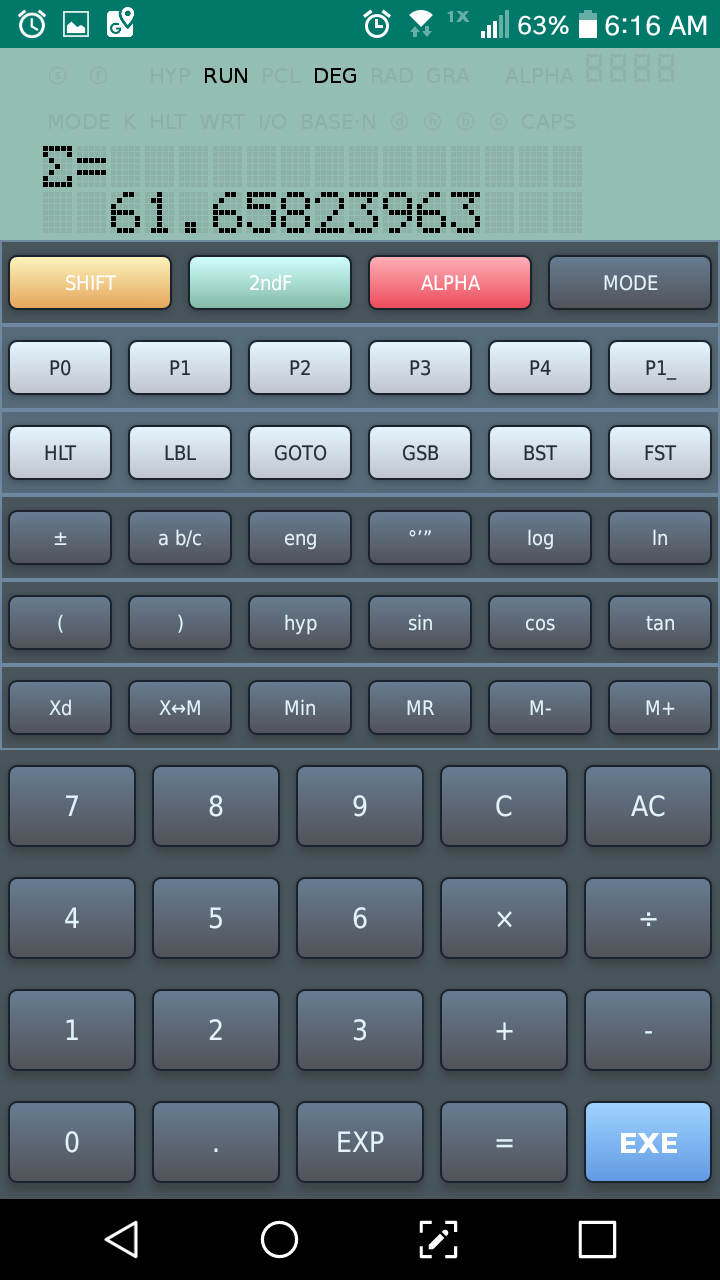
Fun with Radio Shack EC-4019 and Casio fx-3800P
First blog entry of the 10th year of this blog (4/11/2020 - 4/11/2021). I can't expression enough gratitude for your support and comments - Eddie
Sums
n
∑ x = (n^2 + n) / 2
x = 1
Program (9 steps):
ENT
Kin 1
x^2
+
Kout 1
=
÷
2
=
Execution: [ # ] n [ RUN ]
where [ # ] represents program keys [ I ], [ II ], [ III ], and [ IV ] in RUN mode ( [ MODE ] [ . ] )
Example: n = 48, Result: 1176
n
∑ x^2 = n * ((n/3 + 1/2) * n + 1/6 )
x=1
Program (16 steps):
ENT
Kin 1
*
(
Kout 1
x^2
÷
3
+
Kout 1
÷
2
+
6
1/x
=
Execution: [ # ] n [ RUN ]
Example: n = 48, Result: 38024
Horner's Rule: Cubic Polynomials
Calculate p(x) by Horner's Rule where:
p(x) = a*x^3 + b*x^2 + c*x + d = x * ( x * ( a*x + b ) + c ) + d
Program (16 steps):
Kout 5
+
Kout 1
*
(
Kout 4
+
Kout 1
*
(
Kout 2
*
Kout 1
+
Kout 3
=
Execution: x [ Kin ] 1, a [ Kin ] 2, b [ Kin ] 3, c [ Kin ] 4, d [ Kin ] 5. Press [ # ]
Example: x = K1 = 50, a = K2 = 1, b = K3 = 4, c = K4 = 5, d = K5 = -200
Result: 135,050
Head Winds And Cross Winds
Head Winds:
HW = K * cos(D - HDG - V)
Cross Winds:
RCW = K * sin(D - HDG - V)
where:
K = wind velocity (mi/hr) (K1)
D = wind direction with 0° due North, clockwise (degrees) (K2)
HDG = airplane direction with 0° due North, clockwise (degrees) (K3)
V = compass adjustment (K4)
Mode 4: Degrees
Program (13 steps):
Mode
4 // Degree mode
Kout 1
P → R
(
Kout 2
-
Kout 3
-
Kout 4
=
HLT // HW
X ←→ Y // RCW
Execution:
K [ Kin ] 1, D [ Kin ] 2, HDG [ Kin ] 3, V [ Kin ] 4. Press [ # ].
Example:
K = 25 mi/hr = K1
D = 240° = K2
HDG = 280° = K3
V = 0 = K4
Results:
HW: 19.15111108 mi/hr
RCW: -16.09699024 mi/hr
Source: HP 65 Aviation Pac-1 Hewlett Packard. 1974
Rate of Climb
Rate of Climb (ft/min):
ROC = TAS * ALT ÷ √( DIST^2 + ALT^2 )
where:
TAS = true airplane speed (ft/min) (K1)
ALT = vertical distance (ft) (K2)
DIST = horizontal distance (ft) (K3)
Conversion factors:
1 knot = 101.269 ft/min
1 nautical mile = 6072.12 ft
Program (13 steps):
Kout 1
*
Kout 2
÷
(
Kout 2
x^2
+
Kout 3
x^2
)
√
=
Execution:
TAS [ Kin ] 1, ALT [ Kin ] 2, DIST [ Kin ] 3. Press [ # ].
Example:
TAS = 4,300 ft/min = K1
ALT = 3,000 ft = K2
DIST = 81,425 ft = K3
Result: ROC: 158.3205808 ft/min
Source: HP 65 Aviation Pac-1 Hewlett Packard. 1974
Modulus
For positive integers N, M:
N mod M = ( N / M - int(N / M) ) * M
Results lie in the interval [ -int( M / 2 ), int( M / 2 ) ]
Program (16 steps):
MODE
7
0 // Fix 0 mode
Kout 2
1/x
*
Kout 1
=
Kin 3
-
Kout 3
RND // round displayed number to settings
=
*
Kout 2
=
Execution:
N [ Kin ] 1, M [ Kin ] 2. Press [ # ].
Examples:
48 mod 17 = -3 (equivalent to 48 mod 17 = 14)
721 mod 21 = 7
Eddie
All original content copyright, © 2011-2020. Edward Shore. Unauthorized use and/or unauthorized distribution for commercial purposes without express and written permission from the author is strictly prohibited. This blog entry may be distributed for noncommercial purposes, provided that full credit is given to the author.
First blog entry of the 10th year of this blog (4/11/2020 - 4/11/2021). I can't expression enough gratitude for your support and comments - Eddie
Sums
n
∑ x = (n^2 + n) / 2
x = 1
Program (9 steps):
ENT
Kin 1
x^2
+
Kout 1
=
÷
2
=
Execution: [ # ] n [ RUN ]
where [ # ] represents program keys [ I ], [ II ], [ III ], and [ IV ] in RUN mode ( [ MODE ] [ . ] )
Example: n = 48, Result: 1176
n
∑ x^2 = n * ((n/3 + 1/2) * n + 1/6 )
x=1
Program (16 steps):
ENT
Kin 1
*
(
Kout 1
x^2
÷
3
+
Kout 1
÷
2
+
6
1/x
=
Execution: [ # ] n [ RUN ]
Example: n = 48, Result: 38024
Horner's Rule: Cubic Polynomials
Calculate p(x) by Horner's Rule where:
p(x) = a*x^3 + b*x^2 + c*x + d = x * ( x * ( a*x + b ) + c ) + d
Program (16 steps):
Kout 5
+
Kout 1
*
(
Kout 4
+
Kout 1
*
(
Kout 2
*
Kout 1
+
Kout 3
=
Execution: x [ Kin ] 1, a [ Kin ] 2, b [ Kin ] 3, c [ Kin ] 4, d [ Kin ] 5. Press [ # ]
Example: x = K1 = 50, a = K2 = 1, b = K3 = 4, c = K4 = 5, d = K5 = -200
Result: 135,050
Head Winds And Cross Winds
Head Winds:
HW = K * cos(D - HDG - V)
Cross Winds:
RCW = K * sin(D - HDG - V)
where:
K = wind velocity (mi/hr) (K1)
D = wind direction with 0° due North, clockwise (degrees) (K2)
HDG = airplane direction with 0° due North, clockwise (degrees) (K3)
V = compass adjustment (K4)
Mode 4: Degrees
Program (13 steps):
Mode
4 // Degree mode
Kout 1
P → R
(
Kout 2
-
Kout 3
-
Kout 4
=
HLT // HW
X ←→ Y // RCW
Execution:
K [ Kin ] 1, D [ Kin ] 2, HDG [ Kin ] 3, V [ Kin ] 4. Press [ # ].
Example:
K = 25 mi/hr = K1
D = 240° = K2
HDG = 280° = K3
V = 0 = K4
Results:
HW: 19.15111108 mi/hr
RCW: -16.09699024 mi/hr
Source: HP 65 Aviation Pac-1 Hewlett Packard. 1974
Rate of Climb
Rate of Climb (ft/min):
ROC = TAS * ALT ÷ √( DIST^2 + ALT^2 )
where:
TAS = true airplane speed (ft/min) (K1)
ALT = vertical distance (ft) (K2)
DIST = horizontal distance (ft) (K3)
Conversion factors:
1 knot = 101.269 ft/min
1 nautical mile = 6072.12 ft
Program (13 steps):
Kout 1
*
Kout 2
÷
(
Kout 2
x^2
+
Kout 3
x^2
)
√
=
Execution:
TAS [ Kin ] 1, ALT [ Kin ] 2, DIST [ Kin ] 3. Press [ # ].
Example:
TAS = 4,300 ft/min = K1
ALT = 3,000 ft = K2
DIST = 81,425 ft = K3
Result: ROC: 158.3205808 ft/min
Source: HP 65 Aviation Pac-1 Hewlett Packard. 1974
Modulus
For positive integers N, M:
N mod M = ( N / M - int(N / M) ) * M
Results lie in the interval [ -int( M / 2 ), int( M / 2 ) ]
Program (16 steps):
MODE
7
0 // Fix 0 mode
Kout 2
1/x
*
Kout 1
=
Kin 3
-
Kout 3
RND // round displayed number to settings
=
*
Kout 2
=
Execution:
N [ Kin ] 1, M [ Kin ] 2. Press [ # ].
Examples:
48 mod 17 = -3 (equivalent to 48 mod 17 = 14)
721 mod 21 = 7
Eddie
All original content copyright, © 2011-2020. Edward Shore. Unauthorized use and/or unauthorized distribution for commercial purposes without express and written permission from the author is strictly prohibited. This blog entry may be distributed for noncommercial purposes, provided that full credit is given to the author.