Showing posts with label HHC 2013. Show all posts

Sunday, September 22, 2013

HHC 2013 - Day 2 Highlights

The Morning Panel

The morning started off with a Q&A panel. The speakers were Ruth Patterson, Jason Smith, Cyrille de Brebisson, and Tim Wessman of the HC Calculator Group.

* The education market was a primary topic of the session, and how HP calculators, such as the Prime and 39gii, along with connectivity software play a role in education.
* The contrast of the keys and keyboard were discussed and how important it is to the user in terms of readability and usability. Note that most HP calculators the color of the type on the keys are black or white for the primary functions, and blue and orange for the shifted functions.
* There was a discussion of how the calculators can be used in both educational and professional settings.
* The HP Prime was named as such because the team wanted a mathematical term for a name, and to differentiate it from prior calculators which had numerical names.

At the end of the session the HHC committee presented two plaques: one to Cyrille de Brebisson for 15 years of being part of the calculator community and innovation, and one to Tim Wessman for 10 years.

David Ramsey - HP 85

David Ramsey talked about the HP 85 computer, and it is a beauty. Manufactured in 1980, the 85 had 16K of RAM that could be expanded to 64K. Only catch was up to 32K could be used for programming. It is a stand alone machine complete with printer. The screen is a 256 x 192 monochrome screen.

Plotting is limited on the HP 85; the pen could draw the axis, tick marks, lines, and points. However graphic buffers can be saved and restored. Processing can slow due to the limited amount of pins in the processor. The tape drive originally ran on DIC 100 cassettes, which had a limited life. Ramsey had his HP 85 modified so that QIC tapes are used. The back of the 85 had four ports, which a port can hold a drawer holding up to 6 ROM cartridges.

Calculators Are Awesome

Dan McDonald (I hope I get his name right, apologies if I don't) stated he like calculators because they are like puzzles and use allowed the our brains to be exercised. Namir Shammas commented that calculators are accessible devices. I agree with both gentlemen.

Readable 41 Bar Codes & Programs

Jake Schwartz and Jackie Woldering showed a project they completed. Everyone at the conference received two DVDs:

* A four-volume set of notes from previous PPC conferences, calculator journals, conference proceedings from Australian conferences, notes from all of the previous HHC conferences, and HP 41 programs, 1,343 programs consisting of 5,844 pages, complete with bar codes and dot data files. We thank both Jake and Jackie for hours and hours and hours of hard work, typing, and dedication to this project.
* A DVD of 1970s calculator ads.

Charles McCord: Life at HP

Charles McCord (again, apologizes if I have the name wrong) spoke about his life working at Hewlett Packard. He was inspired to save money over the last two years of high school and some of the first year in college to purchase a HP 65 after his father bought a HP 45, and how to understand how calculators work.

When working for HP in Corvallis, McCord started as a quality engineer working with the HP 41. He lead a team develop a modem for the HP 75, which gave it additional memory and power, at the request of AT&T. He was also a manager for the single chips produced for the HP 10 series. McCord also lead a group of engineers to develop printers and mini-computers in Vancouver and San Diego.

Some funny antidotes during his time at HP were:

* One of his supervisors was humorously given an HP 41C glued to a car battery since heavy ROM use easily ate up the battery.
* The first modem cases for the HP 75 were fine except the computers were resetting. Turns out the case pressed the keys for a soft reset. Plastic shields that were added to the case took care of the problem.
* In a test group for the original HP 12C, one of the NAND gates were locked, causing a row of commas to fill the screen each time the ON and decimal point keys were simultaneously pressed. Those calculators were not sold.
* People returned their otherwise working HP 12Cs after several years of use because the batteries lasted so long, they did not realize that the batteries died.

McCord now works for Aptima.

Final Panel, Prizes, and a Tour

A final panel assembled by Joe Horn, Cyrille de Brebisson, Jeremy Smith, Goeff Quickfall, Wlodek Mier-Jędrzejowicz, and Jim Donnelly takes about the adventures and misadventures of publishing.

Contest Winners:

Best Speaker, as voted by the attendees, went to Geoff Quickfall.

RPN Programming Contest Winner: Eric Smith

RPL Programming Contest Winner: Bill Butler

Congratulations to all the winners. I believe you can find details of the RPN and RPL contests on the HHC 2013 page and the HP Museum of Calculator Forum.

Of course, no conference is not complete with door and premium prizes. And there was enough to go around for all 56 attendees at least once. It was by random drawing and whoever gets called gets a choice of donated goodies. Here is what I won:

An HP 38G (1995). This is the beginning of the 38G/39G/40G/Prime family. Thanks to whoever donated the calculator.

For the record, I took two slide rules and printed two dairies of HP calculator programs that I wrote for various calculators.

Then there are the premium prizes, those donated items deemed by the community to be very valuable and/or unique. While I wasn't lucky enough to win a premium prize (but that is how I won my HP-71B two years ago) some of the premium prizes were:

* HP 65 in its box with accessories
* HP 75 in its box with accessories
* HP 25 with its charger and pouch. A good iOS emulator is the GO-25.
* HP 71-B
* HP 15C Limited Edition in its box, unopened (2)
* HP 48GX with a black LCD screen. 48GX calculators with black LCD screens are rare because they were the last 48GX to be produced. Most 48GX (and 48s in general) have blue LCD screens.
* Microsoft Surface Tablet
* HP calculator carrying case (2)

I am not sure if the names of the winners are posted on the HHC 2013 web site.

Tim Wessman took a group of us on a tour of the office, where testing of calculators and connectivity software takes place.

I had to leave to get to my hotel to connect for my ride to the airport. I probably have missed out on closing remarks and the after-conference party. I have to be back to work the following Monday.

Once again, my heartfelt gratitude to all the attendees and the committee, a lot who have become friends, and to Hewlett Packard. You are a big reason why math and calculators are lifelong loves for me.


Another conference has come and gone. Had a blast as always. Time flies when we are having fun. And I will talk to you next time!

Eddie


This blog is property of Edward Shore. 2013

Saturday, September 21, 2013

HHC 2013: Day 1 Highlights

First of all, thanks to Hewlett Packard and everyone at the HHC 2013 committee (http://hhuc.us/2013/committee.htm) - you are all amazing!

What a long, fun, and intense day. Here are some of the highlights from today:

The HP Prime Has Arrived!

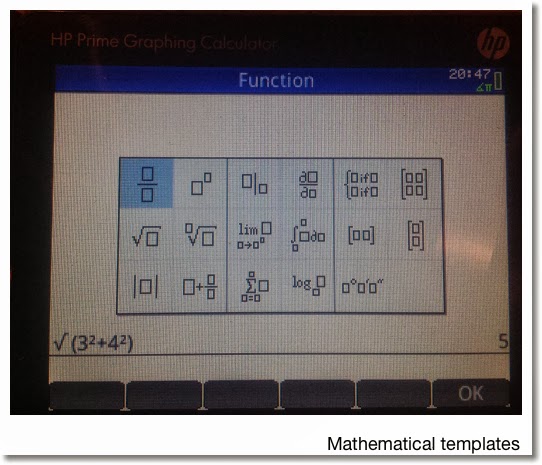
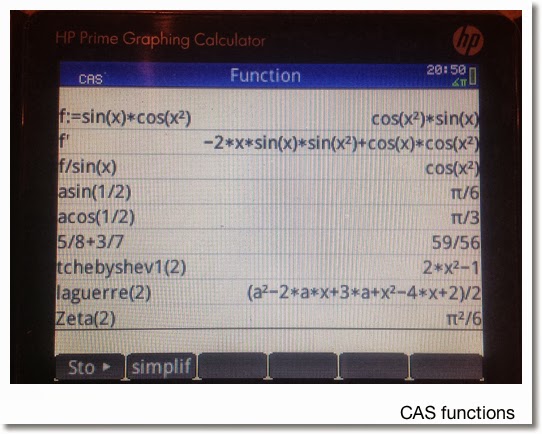
The new HP Prime is available! Prime, I believe is HP's first color graphing calculator. Features include a computer algebra system mode (CAS), graphing which includes geometry including slope-fields of differential equations, equation solver, full operational touch screen including finger scrolling and selecting, a spreadsheet application, and my favorite new feature: advanced graphing (color implicit graphing)! Below are pictures of the Prime:

Some more specifics:

* Super advanced functions including the special functions Gamma, Beta, Zeta, Si, Ci, Psi, and Error.
* Polynomials functions include Hermite, Lagrange, Laguerre, Legendre, Chebyshev, Cyclomotic, and Groebner.
* The programming language is similar to the programming of the HP 39gii and 39gs.
* Rechargeable battery with indicator.
* 240 x 320 full color pixel screen.
* App structure similar to the HP 38G/39G family. (And 40G for those living outside the United States).
* The connectivity kit is dynamic, you can update the calculator and the emulator in real time.
* RPN mode.
* Intelligent, multi-use programming commands.
* Battery life lasts a good long time, I am told up to 23 days under normal use. Of course, use varies is dependent on how intense the calculation is used.

Where can I get one? So far hpcalc.org, Bach Company, Samson Cables, and yes, even eBay has calculators for sale. Availability varies.

How much does the Prime cost? Approximately $130 to $150 (U.S. dollars).

I am looking to work with several of my friends and HP calculator enthusiasts on a Wiki page. Details are coming soon. And of course, I will be talking a lot more about Prime on this blog as well.

We spent three hours without blinking talking about Prime this morning with Tim Wessman and Cyrille de Brebisson.

Once again, thanks to all the speakers. It is one of my goals to actually have a presentation next year.

Jim Donnelly: Visualizing Data: A Journey From Calculator Development to the Machine Shop

Jim is the author of the several books on HP Calculators, including the "HP 48 Handbook". His contributions include adding drawing peripherals to classic HP calculators, the HP-71B Data Acquisition Pac, the Periodic Table for the HP 48G Series, and gave the legendary HP-01 calculator watch a new tool: a battery door opener. Jim also engraves designs and lettering onto aluminum plates, which includes a cryptic engraving "6accdae13eff7i3l9n4o4qrr4s8t12vx". It has something to do with calculus.

Other Highlights

Jim Johnson, from. Indianapolis, restored a HP-29C from a dead calculator to a full working one. He detailed how he took the calculator apart, cleaned the keyboards, gave it new batteries, and diagramed the electronics of the calculator.

Tip: Do not plug a Woodstock calculator (HP 21 to HP 29, 1970s) unless it had a good battery. Otherwise, the battery may get fried.

Namir Shammas highlighted some of his favorite functions of the HP Prime: extensive random number generators, advanced mathematical functions, and matrix factorization. His article can found in the September 2013 of HP Solve. (http://h20331.www2.hp.com/hpsub/downloads/hp_calculator_enl_sep_2013_v4.pdf)

Eric Smith, who is on a mission to build a working RPN (Reverse Polish Notation) calculator from scratch. After several years of research he is able to pass around two working demos: one that emulates the HP-41 and one that emulates HP-42 (the latter by popular demand). Everything is open source. Smith is now working on how to get the SD card inserted into calculator and fully working. During his talk a poll was taken and the majority of attendees preferred AA batteries over AAA and button sized batteries.

Jeremy Smith brought new life to road dots. A road dot the small circular numb that lines the lanes on our streets. He had designed several spherical pieces using road dots. He has also constructed a folding block of sixteen half-cubes connected by a string and a folding chess board.

Wlodek Mier-Jędrzejowicz received an appreciation award for thirty years of contributions to the Hewlett Packard calculator community. Congratulations and well deserved!

Gene Wright brought his collection of HP OmniBooks, which were manufactured in the 1990s, for show and tell. OmniBooks started as small notebooks (EX: 300) and by the end of their production run, they were full laptops (EX: EX3). Wright's collection focused on the earlier models.

Some specs of the OmniBook 300:
* 20 MHz Processor
* 9" diagonal grayscale screen
* Windows 3.1 Operating System
* Microsoft Office built into the ROM
* HP Calculator Application: Runs like the HP 19B except with a full keyboard.
* The mouse lived inside the notebook, came out with a press of a button.

Wright's collection includes the OmniBook 600C and OmniBook 530, with a broken screen.

Geoff Quickfall, a pilot who flies internationally, showed his typical workday. He uses the following HP Calculators on his flight:
* HP01 for active its timer feature so the crew can tell its passengers when they will arrive at their destination. Also the dynamic time features allows him to calculate how much fuel is used.
* HP 71B for matching and verifying latitudes at certain points of the flight.
* HP 41C with memory module to estimate the distance between airports. Quickfall also programmed the longitude and latitude coordinates of airports he flies to. The 41C is also used to print and organize break schedules for the flight crew.
* HP 42S for to calculate the fuel left in the tank (by weight), and to see if the fuel levels passes standards.
* HP 67, 29C, and 48 G are also used

IMHO, I am a little jealous - I wish I could use one advanced calculator at my job on a regular basis. But accounting does not use mathematics beyond arithmetic 99.9% of the time.

The day closed with Wlodek Mier-Jederzejowick showing us his latest edition of "A Guide to HP Handheld Calculators and Computers".

There you have it - the highlights. I will report on Day 2, hopefully tomorrow.

Eddie

This blog is property of Edward Shore. 2013

HHC 2013

Greetings from Fort Collins, CO!

I am here at Fort Collins, CO attending the annual HHC (HP Handheld Conference 2013). Basically, this is what ComicCon would be for calculator enthusiasts, particularly calculators made by Hewlett Packard.

This is my sixth conference I had attended over the last decade. HHC is a two day conference taking place over the weekend. We usually fly/drive to our destination on Friday - meet and have dinner. There are some attendees who go on torus and field trips. Saturday is our intense day - we literally start from sunrise to at least 9:00 at night. Sunday is more relaxed, and that is where we have contests and door prize drawings.

The web site of the conference is: http://hhuc.us/2013/index.htm, which takes place this weekend. HHC takes place during September.

Over the weekend, if I am able to, I will relay some of the highlights. Until then, have a great day!


Eddie


This blog is property of Edward Shore. 2013

HP 42S/DM42/Free 42: Two Functions Programmed Three Different Ways

HP 42S/DM42/Free 42: Two Functions Programmed Three Different Ways Introduction In 1979, Electro Scientific Industries (esi)...