Showing posts with label March Calculus Madness. Show all posts

Thursday, March 31, 2022

March Calculus Madness Sweet Sixteen - Day 16: A Parametric Integral Example

 ------------


Welcome to March Calculus Madness!


------------


Let:

x(t) = a * cos t

y(t) = b * sin t


Then:

∫ y(x) dx = ∫ y(t) * x'(t) dt


x'(t) = -a * sin t


And:

∫ y(t) * x'(t) dt

= ∫ -a * sin t * b * sin t dt

= -a * b * ∫ sin^2 t dt

= -a * b * ∫1/2 - 1/2 * cos(2*t) dt

= -a * b * (t/2 - sin(2*t)/4) + C


That wraps up March Calculus Madness 2022.  


Next Post:  April 9, 2022


Have a great day and hope you enjoyed the series!  


Eddie 


All original content copyright, © 2011-2022.  Edward Shore.   Unauthorized use and/or unauthorized distribution for commercial purposes without express and written permission from the author is strictly prohibited.  This blog entry may be distributed for noncommercial purposes, provided that full credit is given to the author. 


Wednesday, March 30, 2022

March Calculus Madness Sweet Sixteen - Day 15: r = α * (1 - cos Θ)

 ------------


Welcome to March Calculus Madness!


------------


r = α * (1 - cos Θ)


r = α * (1 - cos Θ)

r^2 = α^2 * (1 - 2 * cos Θ + cos^2 Θ)


dr/dΘ = α * sin Θ

(dr/dΘ)^2 = α^2 * sin^2 Θ


Area from 0 ≤ Θ ≤ 2*π


1/2 * ∫ α^2 * (1 - cos Θ)^2  dΘ from Θ = 0 to Θ = 2*π

= α^2/2 * ∫ 1 - 2 * cos Θ + cos^2 Θ dΘ from Θ = 0 to Θ = 2*π

= α^2/2 * ∫ 1 - 2 * cos Θ + 1/2 * cos(2*Θ) + 1/2 dΘ from Θ = 0 to Θ = 2*π

= α^2/2 * (3/2 * Θ - 2 * sin Θ + 1/4 * sin(2*Θ) from Θ = 0 to Θ = 2*π)

= 3/2 * π * α^2


Arc Length from 0 ≤ Θ ≤ 2*π


r^2 + (dr/dΘ)^2

= α^2 * (1 - 2 * cos Θ + cos^2 Θ) + α^2 * sin^2 Θ

= α^2 - 2  * α^2 * cos Θ + α^2 * (cos^2 Θ + sin^2 Θ)

= α^2 - 2  * α^2 * cos Θ + α^2 

= 2 * α^2 - 2 * α^2 * cos Θ

= 2 * α^2 *(1  - cos Θ)


Arc Length:

∫ 2 * α^2 *(1  - cos Θ) dΘ from Θ = 0 to Θ = 2*π

= α * √2 * ∫ √(1  cos Θ) dΘ from Θ = 0 to Θ = 2*π

= α * √2 * 4 * √2

= 8 * α


Eddie 


All original content copyright, © 2011-2022.  Edward Shore.   Unauthorized use and/or unauthorized distribution for commercial purposes without express and written permission from the author is strictly prohibited.  This blog entry may be distributed for noncommercial purposes, provided that full credit is given to the author. 


Tuesday, March 29, 2022

March Calculus Madness Sweet Sixteen - Day 14: The Arc Length of a Spiral

 ------------


Welcome to March Calculus Madness!


------------


The Length of a Spiral from 0 ≤ Θ ≤ m


The equation of a spiral:  r = α * Θ


The arc length of a polar equation r(Θ):  ∫ √(r(Θ)^2 + (dr/dΘ)^2) dΘ


r = α * Θ

r^2 = α^2 * Θ^2


dr = α dΘ

(dr/dΘ)^2 = α^2


∫ √(α^2 * Θ^2 + α^2) dΘ from Θ = 0 to Θ = m

= α * ∫ √(Θ^2 + 1) dΘ from Θ = 0 to Θ = m

= α/2 * ( ln|Θ + √(1 + Θ^2)| + Θ * √(1 + Θ^2) for Θ = 0 to Θ = m)

(see below)

= α/2 * ( ln|m + √(1 + m^2)| + m * √(1 + m^2) )


Aside:

∫ √(1 + Θ^2) dΘ


Let Θ = tan x

dΘ = sec^2 x dx


∫ √(1 + Θ^2) dΘ

= ∫ √(1 + tan^2 x) * sec^2 x  dx

= ∫ √(sec^2 x) * sec^2 x dx

= ∫ sec^3 x dx

= 1/2 * ∫ sec x dx + (sec x * tan x)/2 + C

(per reduction integration rule for sec x)


= 1/2 * ln|tan x + sec x| + 1/2 * sec x * tan x + C


with: 

Θ = tan x

arctan Θ = x

sec(arctan Θ) = sec x

√(1 + x^2) = sec x


= 1/2 * ln|Θ + √(1 + Θ^2)| + 1/2 * Θ * √(1 + Θ^2) + C


Eddie 


All original content copyright, © 2011-2022.  Edward Shore.   Unauthorized use and/or unauthorized distribution for commercial purposes without express and written permission from the author is strictly prohibited.  This blog entry may be distributed for noncommercial purposes, provided that full credit is given to the author. 

Monday, March 28, 2022

March Calculus Madness Sweet Sixteen - Day 13: Some Double Integrals

 ------------


Welcome to March Calculus Madness!


------------


Double Integration Time


(I) 

∫ ∫ sin(a*x + b*y) dx dy

= ∫ -1/a * cos(a*x + b*y) + C1 dy

= -1/(a*b) * sin(a*x + b*y) + C1*y + C2


(II) 

∫ ∫ sin(a*x + b*y) dy dx

= ∫ -1/b * cos(a*x + b*y)+ C1 dx

= -1/(a*b) * sin(a*x + b*y) + C1 * x + C2


For (I) and (II) to equal,  x = y


(III)

∫ ∫ e^(a*x + b*y) dx dy

= ∫ 1/a * e^(a*x + b*y)+ C1 dy

= 1/(a*b) * e^(a*x + b*y) + C1 * y + C2


(IV)

∫ ∫ e^(a*x + b*y) dy dx

= ∫ 1/b * e^(a*x + b*y) + C1  dx

= 1/(a*b) * e^(a*x + b*y) + C1 * x + C2


For (III) and (IV) to be equal, x = y


Eddie


All original content copyright, © 2011-2022.  Edward Shore.   Unauthorized use and/or unauthorized distribution for commercial purposes without express and written permission from the author is strictly prohibited.  This blog entry may be distributed for noncommercial purposes, provided that full credit is given to the author. 


Sunday, March 27, 2022

March Calculus Madness Sweet Sixteen - Day 12: Arc Length of Sine and Cosine

 ------------


Welcome to March Calculus Madness!


------------


What is the arc length of y = sin x and y = cos x from x = 0 to x = 2 * π


The arc length of y(x) is calculated by:


∫ √(1 + (dy/dx)^2) dx for x = a to x = b


For y(x) = sin x, dy/dx = cos x, (dy/dx)^2 = cos^2 x


Arc length of y = sin x from x = 0 to x = 2*π

∫ √(1 + cos^2 x) dx for x = 0 to x = 2*π ≈ 7.64039557806


Likewise, for y(x) = cos x, dy/dx = -sin x, (dy/dx)^2 = sin^2 x

∫ √(1 + sin^2 x) dx for x = 0 to x = 2*π ≈ 7.64039557806


Yes, the arc lengths are the approximately the same.  


Eddie


All original content copyright, © 2011-2022.  Edward Shore.   Unauthorized use and/or unauthorized distribution for commercial purposes without express and written permission from the author is strictly prohibited.  This blog entry may be distributed for noncommercial purposes, provided that full credit is given to the author. 


Saturday, March 26, 2022

March Calculus Madness Sweet Sixteen - Day 11: ∫ int(x) dx

 ------------


Welcome to March Calculus Madness!


------------


f(x) = IP(x), integer function, HP Prime


int(x):  integer part function


Domain:

0 ≤ x < 1;  int(x) = 0

1 ≤ x < 2;  int(x) = 1

2 ≤ x < 3;  int(x) = 2

3 ≤ x < 4;  int(x) = 3


Hence:


∫ int(x) dx for x = 1 to x = 2 

= lim a→2- ∫ 1 dx for x = 1 to x = a

= lim a→2-  a - 1

= 2 - 1

= 1


∫ int(x) dx for x = 2 to x = 3 

= lim a→3- ∫ 1 dx for x = 1 to x = a

= lim a→3-  2 * a - 2 * 2

= 2 * 3 - 4 

= 2


∫ int(x) dx for x = 3 to 4 

= lim a→4- ∫ 1 dx for x = 1 to a

= lim a→4-  3 * a - 3 * 3 

= 4 * 3 - 9

= 3


and so on...


∫ int(x) dx for x = 1 to x =3 

= (∫ int(x) dx for x =1 to x=2 )+ (∫ int(x) dx for x =2 to x=3) + (∫ int(x) dx for x=3 to x=4 )

= 1 + 2 + 3

= 6


The General Integral ∫ int(x) dx for x = 1 to x = t


∫ int(x) dx for x = 1 to x = t

= ∫ int(x) dx for x = 1 to x = int(t) + ∫ int(x) dx for x = int(t) to x = t

= lim a→int(t)- ∫ int(x) dx for x = 1 to x = a + ∫ int(x) dx for x = int(t) to x = t

= (1 + 2 + 3 + 4 + .... + t-1) + t * int(t) - int(t) * int(t)

= t * (t-1)/2 + t * int(t) - int^2(t)


Example:


∫ int(x) dx for x = 1 to x = 8.3

= (7 * 8)2 + (8.3 * 8 - 8^2)

= 30.4


Eddie 


All original content copyright, © 2011-2022.  Edward Shore.   Unauthorized use and/or unauthorized distribution for commercial purposes without express and written permission from the author is strictly prohibited.  This blog entry may be distributed for noncommercial purposes, provided that full credit is given to the author. 


Friday, March 25, 2022

March Calculus Madness Sweet Sixteen - Day 10: ∫ frac(x) dx

 ------------


Welcome to March Calculus Madness!


------------


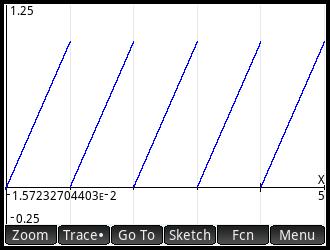
frac(x) - HP Prime


frac(x):  fractional part function


Domain:  0 ≤ frac(x) < 1


∫ frac(x) dx for x = 0 to 1


According to the graph above, the area between resembles as a right triangle.


When 0≤x<1, frac(x) = x


Hence:

∫ frac(x) dx for x = 0 to x = 1


Note:  

lim a→1-  (∫ frac(x) dx for x = 0 to x = a)

= lim a→1-  (∫ x dx for x = 0 to x = a)

= lim a→1-  (∫ x dx for x = 0 to x = a)

= lim a→1-  (a^2/2 - 0)

= 1/2


What if the upper limit is less than 1? 


Let b where, 0≤x≤b<1  (b<1):


∫ frac(x) dx for x = 0 to x = b

= ∫ x dx for x = 0 to x = b

= b^2/2


Eddie 


All original content copyright, © 2011-2022.  Edward Shore.   Unauthorized use and/or unauthorized distribution for commercial purposes without express and written permission from the author is strictly prohibited.  This blog entry may be distributed for noncommercial purposes, provided that full credit is given to the author. 


Thursday, March 24, 2022

March Calculus Madness Sweet Sixteen - Day 9: ∫ e^x/(e^x + 1) dx and ∫ e^x/(e^x - 1) dx

 ------------


Welcome to March Calculus Madness!


------------


∫ e^x/(e^x + 1) dx


Let z = e^x

Then: 

ln z = x

1/z dz = dx


∫ e^x/(e^x + 1) dx

= ∫ z/(z + 1) * 1/z dz

= ∫ 1/(z + 1) dz

= ln |z + 1| + C

= ln |e^x + 1| + C


∫ e^x/(e^x - 1) dx


Again, let z = e^x


∫ e^x/(e^x - 1) dx

= ∫ z/(z - 1) * 1/z dz

= ∫ 1/(z - 1) dz

= ln |z - 1| + C

= ln |e^x - 1| + C


Eddie 


All original content copyright, © 2011-2022.  Edward Shore.   Unauthorized use and/or unauthorized distribution for commercial purposes without express and written permission from the author is strictly prohibited.  This blog entry may be distributed for noncommercial purposes, provided that full credit is given to the author. 


Wednesday, March 23, 2022

March Calculus Madness Sweet Sixteen - Day 8: ∫ ln^2 x dx and ∫ ln^3 x dx

 ------------


Welcome to March Calculus Madness!


------------


Integration by parts to the rescue!


∫ ln^2 x dx


u = ln^2 x,   dv = dx

du = 2 * ln * 1/x dx,   v = x


∫ ln^2 x dx

= x * ln^2 x - ∫ 2 * ln x * 1/x * x dx

= x * ln^2 x - ∫ 2 * ln x dx


u = ln x, dv = 2 dx

du = 1/x dx, v = 2 * x


= x * ln^2 x - (2 * x * ln x - ∫ 1/x * 2 * x dx)

= x * ln^2 x - (2 * x * ln x - ∫ 2 dx)

= x * ln^2 x - 2 * x * ln x + ∫ 2 dx

= x * ln^2 x - 2 * x * ln x + 2 * x + C


∫ ln^3 x dx


u = ln^3 x dx, dv = dx

du = 3 * ln^2 x dx, v = x


= x * ln^3 x - ∫3 * ln^2 x * 1/x * x dx

= x * ln^3 x - 3 * ∫ ln^2 x dx

= x * ln^3 x - 3 * (x * ln^2 x - 2 * x * ln x + 2 * x + C)

(see the above)

=  x * ln^3 x - 3 * x * ln^2 x + 6 * x * ln x - 6 * x + D   

(where D = 3 * C, C and D are constants)


Eddie


All original content copyright, © 2011-2022.  Edward Shore.   Unauthorized use and/or unauthorized distribution for commercial purposes without express and written permission from the author is strictly prohibited.  This blog entry may be distributed for noncommercial purposes, provided that full credit is given to the author. 


Tuesday, March 22, 2022

March Calculus Madness Sweet Sixteen - Day 7: ∫ 1/(1 + cos x) dx and ∫ 1/(1 + sin x) dx

 ------------


Welcome to March Calculus Madness!


------------


∫ 1/(1 + cos x) dx and ∫ 1/(1 + sin x) dx


To tackle these integrals, we will make use of the following derivatives and trig identities:


d/dx tan x = sec^2 x dx


d/dx cot x = -csc^2 x dx


d/dx csc x = -cot x * csc x


d/dx sec x = tan x * sec x


sin^2 x + cos^2 x = 1


cot x = 1/tan x,  csc x = 1/sin x,  sec x = 1/cos x


∫ 1/(1 + cos x) dx

= ∫ 1/(1 + cos x) * (1 - cos x)/(1 - cos x) dx

= ∫ (1 - cos x)/(1 - cos^2 x) dx

= ∫ (1 - cos x)/sin^2 x dx

= ∫ csc^2 x - cot x * csc x dx

= -cot x + csc x + C


∫ 1/(1 + sin x) dx

= ∫ 1/(1 + sin x) * (1 - sin x)/(1 - sin^2 x) dx

= ∫ (1 - sin x)/(1 - sin^2 x) dx

= ∫ (1 - sin x)/(cos^2 x) dx

= ∫ sec^2 x - tan x * sec x dx

= tan x - sec x + C


Note:  CAS systems in graphing calculators will default to using sin x, cos x, and tan x.  


Eddie


All original content copyright, © 2011-2022.  Edward Shore.   Unauthorized use and/or unauthorized distribution for commercial purposes without express and written permission from the author is strictly prohibited.  This blog entry may be distributed for noncommercial purposes, provided that full credit is given to the author. 

Sunday, March 20, 2022

March Calculus Madness Sweet Sixteen - Day 5: x^n ∙ √(1 + x)

 ------------


Welcome to March Calculus Madness!


------------


d/dx x^n ∙ √(1 + x)


Here we can make use the multiplication rule:

d/dx f(x) ∙ g(x) = f(x) ∙ g'(x) + f'(x) ∙ g(x)


In this case:

f(x) = x^n

g(x) = √(1 + x) = (1 + x)^(1/2)


Then:

f'(x) = n ∙ x^(n-1)

g'(x) = 1/2 ∙ (1 + x)^(-1/2)


And: 

d/dx x^n ∙ √(1 + x) 

= x^n ∙ 1/2 ∙ (1 + x)^(-1/2) + n ∙ x^(n-1) ∙ (1 + x)^(1/2)


For indefinite integrals, I will do two specific cases of n.


∫ x ∙ √(1 + x) dx   (n = 1)


Using integration by parts:


u = x,  dv = (1 + x)^(1/2) dx

du = dx,  v = 2/3 ∙ (1+x)^(3/2)


∫ x ∙ √(1 + x) dx

= 2/3 ∙ (1+x)^(3/2) ∙ x - ∫ (1 + x)^(1/2) dx

= 2/3 ∙ (1+x)^(3/2) ∙ x - 2/3 ∙ (1 + x)^(3/2) + C

= 2/3 ∙ (1 + x)^(3/2) ∙ (x - 1) + C


∫ x^2 ∙ √(1 + x) dx   (n = 2)


Let z = (1 + x)^(1/2)

dz = 1/2 ∙ (1+ x)^(-1/2) dx

2 ∙ (1+x)^(1/2) dz = dx

2 ∙ z  dz = dx


z^2 = 1 + x

z^2 - 1 = x

z^4 - 2 ∙ z^2 + 1 = x^2


∫ x^2 ∙ √(1 + x) dx   

= ∫ (z^4 - 2 ∙ z^2 + 1) ∙ z ∙ 2 ∙ z dz

= ∫ (z^4 - 2 ∙ z^2 + 1) ∙ 2 ∙ z^2 dz

= ∫ 2 ∙ z^6 - 4 ∙ z^4 + 2 ∙ z^2 dz

= 2/7 ∙ z^7 - 4/5 ∙ z^5 + 2/3 ∙ z^3 + C

= 2/7 ∙ (1 + x)^(7/2) - 4/5 ∙ (1 + x)^(5/2) + 2/3 ∙ (1 + x)^(3/2) + C

(z = (1 + x)^(1/2))


Eddie


All original content copyright, © 2011-2022.  Edward Shore.   Unauthorized use and/or unauthorized distribution for commercial purposes without express and written permission from the author is strictly prohibited.  This blog entry may be distributed for noncommercial purposes, provided that full credit is given to the author. 


Saturday, March 19, 2022

March Calculus Madness Sweet Sixteen - Day 4: ∫x^2 / √(1 - x^2) dx

 ------------


Welcome to March Calculus Madness!


------------


∫x^2 / √(1 - x^2)  dx


Substitute:  z = arcsin x


sin z = x

sin^2 z = x^2


and dz = 1/√(1 - x^2) dx


Then:


∫x^2 / √(1 - x^2)  dx

= ∫ sin^2 z dz

= ∫  1/2 - 1/2 ∙ cos(2∙z) dz    

(by trigonometric identity of sin^2 z = 1/2 - 1/2 ∙ cos(2∙z))


= z/2 - 1/4 ∙ sin(2∙z) + C

= z/2 - 1/2 ∙ sin z ∙ cos z  + C

(by trigonometric identity of sin(2∙z) = 2 ∙ cos z ∙ sin z)


= 1/2 ∙ arcsin x - 1/2 ∙ sin(arcsin x) ∙ cos(arcsin x) + C

= 1/2 ∙ arcsin x - 1/2 ∙ x ∙ √(1 - x^2) + C

(sin(arcsin x) = x, cos(arcsin x) = √(1 - x^2)


Summary:

∫x^2 / √(1 - x^2)  dx  = 1/2 ∙ arcsin x - 1/2 ∙ x ∙ √(1 - x^2) + C


Eddie


All original content copyright, © 2011-2022.  Edward Shore.   Unauthorized use and/or unauthorized distribution for commercial purposes without express and written permission from the author is strictly prohibited.  This blog entry may be distributed for noncommercial purposes, provided that full credit is given to the author. 


Friday, March 18, 2022

March Calculus Madness Sweet Sixteen - Day 3: Derivative and Integral of x^n∙(1+x)^2

 ------------


Welcome to March Calculus Madness!


------------


x^n ∙ (1 + x)^2

= x^n ∙ (1 + 2 ∙ x + x^2)

= x^n + 2 ∙x^(n+1) + x^(n+2)


d/dx x^n ∙ (1 + x)^2 

= d/dx x^n + 2 ∙x^(n+1) + x^(n+2)

= n ∙ x^(n-1) + 2 ∙ (n+1) ∙ x^n + (n+2) ∙ x^(n+1)


∫ x^n ∙ (1 + x)^2 dx

= ∫ x^n + 2 ∙x^(n+1) + x^(n+2) dx

= x^(n+1)/(n+1) + (2 ∙ x^(n+2))/(n+2) + x^(n+3)/(n+3) + C


Eddie


All original content copyright, © 2011-2022.  Edward Shore.   Unauthorized use and/or unauthorized distribution for commercial purposes without express and written permission from the author is strictly prohibited.  This blog entry may be distributed for noncommercial purposes, provided that full credit is given to the author. 


Thursday, March 17, 2022

March Calculus Madness Sweet Sixteen - Day 2: Derivative and Integral of the Absolute Value Function

 ------------


Welcome to March Calculus Madness!


------------


What is the derivative and the indefinite integral of the absolute value?


By defintion:


| x | = x when x ≥ 0, -x when x < 0


Hence:


d/dx | x | =   1 when x ≥ 0, and -1 when x < 0


and 


∫ | x | dx = x^/2 + C when x ≥ 0, abnd -x^2/2 + C when x < 0


What about |a∙x + b|?


The function |a∙x + b| hits the x-axis when:


a∙x + b = 0

a∙x = -b

x = -b/a


|a∙x + b| = 

(a∙x + b) when x ≥ (-b/a), 

and -(a∙x + b) when < (-b/a)


d/dx |a∙x + b| = 

a when x ≥ (-b/a),

and -A when < (-b/a)


∫ |a∙x + b| dx = 

A ∙ x^2/2 + C  when x ≥ (-b/a), 

and -A ∙ x^2/2 + C  when < (-b/a)


Eddie  


All original content copyright, © 2011-2022.  Edward Shore.   Unauthorized use and/or unauthorized distribution for commercial purposes without express and written permission from the author is strictly prohibited.  This blog entry may be distributed for noncommercial purposes, provided that full credit is given to the author. 


Wednesday, March 16, 2022

March Calculus Madness Sweet Sixteen - Day 1: Double Integration

------------


Welcome to March Calculus Madness!


------------


For the two-variable function f(x,y), can we assume that ∫ ∫ f(x,y) dx dy = ∫∫ f(x,y) dy dx?  


Two simple examples:


Equation 1:

∫ ∫ x^2 + y^2 dx dy

= ∫ x^3/3 + y^2 ∙ x + C1 dy

x^3 ∙ y/3 + y^3 ∙ x/3 + C1 ∙ y + C2


Equation 2: 

∫ ∫ x^2 + y^2 dy dx

∫ x^2 ∙ y + y^3/3 + C1 dx

x^3 ∙ y/3 + y^3 ∙ x/3 + C1∙ x + C2


However, for both Equation 1 and Equation 2 to be equal:

x^3 ∙ y/3 + y^3 ∙ x/3 + C1 ∙ y + C2 = x^3 ∙ y/3 + y^3 ∙ x/3 + C1∙ x + C2

C1 ∙ y = C1 ∙ x

y = x


By this example alone, we cannot assume that ∫ ∫ f(x,y) dx dy = ∫∫ f(x,y) dy dx.


Eddie


All original content copyright, © 2011-2022.  Edward Shore.   Unauthorized use and/or unauthorized distribution for commercial purposes without express and written permission from the author is strictly prohibited.  This blog entry may be distributed for noncommercial purposes, provided that full credit is given to the author. 


First Look: HP 16C Collector's Edition

 First Look: HP 16C Collector's Edition I just got the HP 16C Collector's Edition.   This is the famous HP 16C that specializes in c...